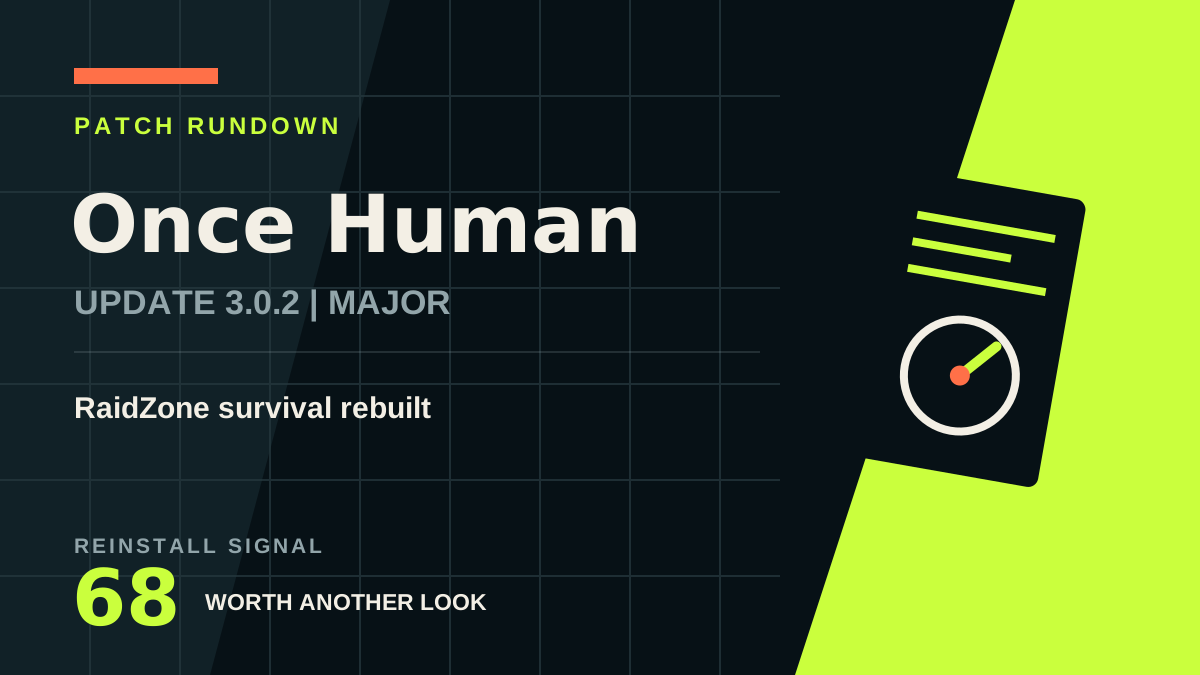
Once Human version 3.0.2 is live on PC and mobile with a wide systems pass centered on RaidZone survival, construction, inventory safety, farming, custom servers, and combat balance. The headline addition is Mental Pollution, but the update reaches far beyond one new hazard.
That breadth produces a Patch Impact Score of 55. The Reinstall Signal is 68, or Worth Another Look. Players invested in building or RaidZone have a clear reason to come back; players focused on unchanged scenarios can treat this as a useful foundation rather than a mandatory return date.
Mental Pollution makes RaidZone preparation more deliberate
RaidZone gains Mental Pollution areas that replace the old Cradle Overload behavior with a Mentality meter. Entering polluted territory steadily reduces Mentality, and hitting zero causes death. New resistance gear and consumable support turn the mechanic into a preparation check rather than a background debuff.
The change benefits organized groups and survival-minded players who want the scenario to demand more than weapon output. It is less friendly to casual returners carrying an old general-purpose loadout. Before heading into a polluted zone, check the new resistance options and confirm that the group understands how Mentality is restored.
A telescope also joins the scenario as a reconnaissance tool, while RaidZone Deviations receive balance changes. These additions should make scouting and encounter composition more consequential, but the official notes do not establish how punishing the new pressure feels in practice.
Building gains precision and safer reuse
Construction pieces can now cycle among valid snap points, reducing the trial-and-error that comes with placing structures in crowded territory. Blueprint behavior has also been adjusted to preserve designs more reliably and make placement less fragile.
Appearance presets become shareable across characters on the same account. For dedicated builders, that is one of the update’s most practical changes: a carefully assembled look no longer has to be recreated character by character.
These tools benefit players who treat territory design as a long-term project. They do not add a new building set or dramatically expand the construction ceiling, but they remove friction from work players were already doing. That makes 3.0.2 more valuable over time than its version number suggests.
Item locks reduce the risk of expensive mistakes
The new item-lock system can protect eligible gear and resources from disassembly, bulk discard, vending-machine listings, and sales to NPCs. Once Human has enough currencies, upgrade materials, and situational equipment that a safety layer matters, particularly for returning players sorting an unfamiliar inventory.
This is also the update’s clearest universal improvement. RaidZone participation is optional, but almost every established account can benefit from marking irreplaceable or high-investment items before cleaning storage.
Farming and breeding receive their own reward and interface changes, while fishing, generators, vending, and other recurring systems get smaller adjustments. None of those changes alone would justify reinstalling, but together they make routine play less cumbersome.
Combat changes are targeted rather than a full reset
Version 3.0.2 adjusts several RaidZone Deviations and revisits the SN700 Finale. The update also corrects combat, interface, building, server, and scenario defects. Players using the affected weapon or Deviations should read their exact entries before trusting an old build.
This is not a global weapon or character rebalance. Most established loadouts remain recognizable, and the update does not ask every player to relearn the complete combat model. The higher returning-player cost comes from the number of surrounding systems moving at once.
Custom servers and technical fixes widen the update’s reach
Custom-server tools receive a substantial rebuild, with more control over rules and configuration. That matters most to community hosts, but it can also change the expectations of players joining privately managed worlds.
The download is sizable on the standalone PC launcher and much smaller through the PC client and mobile stores, according to Starry Studio. The notes also cover a broad collection of fixes rather than claiming one sweeping performance breakthrough. Players with a specific stability concern should verify that exact issue before assuming 3.0.2 resolves it.
One limitation is explicit: the world-switching prompt near safe zones is temporarily disabled. Anyone who relied on that prompt should not expect its old behavior until Starry Studio restores it.
Who benefits, and who can wait
RaidZone regulars gain the strongest immediate case for returning. Builders and players with crowded inventories also benefit from tools that protect work and reduce repetitive setup. Custom-server operators have a separate reason to reassess their configuration.
Players who do not use RaidZone, build extensively, or manage a private world can wait. The update improves many routines, but it does not launch a new scenario or replace the game’s broader progression loop.
Returning Player Tax: C
The Returning Player Tax is C. The core survival and shooting model remains familiar, but RaidZone preparation, Mental Pollution resistance, Deviation balance, construction controls, farming rewards, and custom-server settings all deserve review.
Start by locking valuable inventory items, then inspect resistance equipment before entering RaidZone. Builders should test snap-point cycling on a low-risk structure before altering an established territory.
Compared with version 3.0.1, which was principally a bug-fix release, 3.0.2 is more ambitious. It adds a scenario-wide survival layer and improves several systems that players touch between fights. That combination makes it a genuine return point for RaidZone and building specialists, even if it falls short of a universal reinstall event.