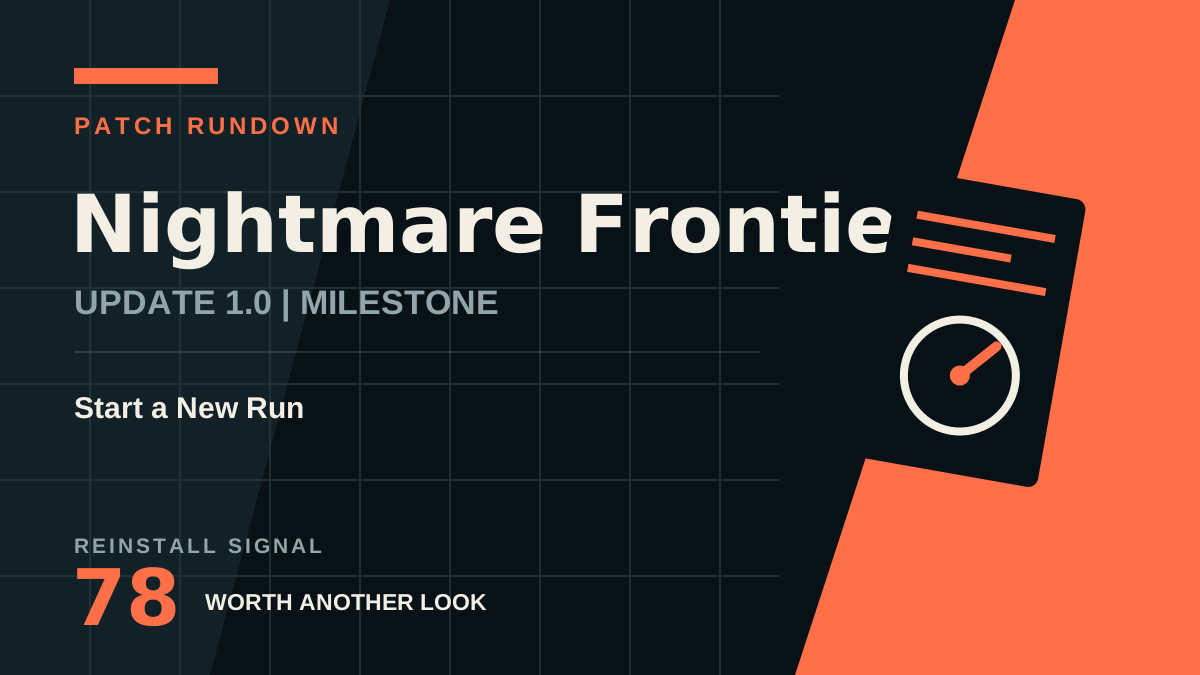
Nightmare Frontier’s version 1.0 release is the point at which the Early Access game asks to be judged as a finished work. Slitherine’s release announcement describes a rewritten narrative, item transfer and swap systems, an overhauled Docks presentation, the Horror status, Dreadweaver susceptibilities, multi-level upgrades, and clearer line-of-sight and line-of-fire rules.
The important word is “finished,†not “preserved.†The official notes say Early Access saves are incompatible with 1.0. A legacy branch remains available for players who want the older version, but the main release is a new run through a revised game.
What changes in the 1.0 build
The narrative rewrite gives the release a different reason to replay even for players who remember the broad outline. This is not only a content-complete switch; the story presentation and the way the game explains its systems have been reworked together.
The Docks art overhaul is the most visible environmental change, while item transfer and swapping address the practical side of preparing a run. Horror status and Dreadweaver susceptibilities add more information to combat decisions. Multi-level upgrades give progression more shape, and clearer line-of-sight and line-of-fire rules should make tactical planning easier to read from the official description.
Those changes favor players who enjoy learning a run-based system through experimentation. They are less helpful to anyone whose main reason for returning is to continue an old save without interruption.
Who benefits most?
New players get the cleanest entry point. They can learn the narrative, combat statuses, item handling, and upgrade structure from the version the developer now treats as the finished game. They do not have to compare old and new rules or wonder whether a remembered route still works.
Returning Early Access players get more content and a more complete presentation, but they pay the full returning-player tax. The save reset removes the shortcut of an established inventory, while the revised systems make old priorities less trustworthy. The legacy branch protects access to the previous build; it does not make the old save useful inside 1.0.
What still needs attention
The save break is the central unresolved cost. It is documented clearly, but clarity does not make it small. Players with a long-running Early Access file need to decide whether the rewritten story and new systems justify starting again. The official announcement also leaves the long-term balance of the new statuses, susceptibilities, and upgrade layers to future play and feedback.
That is why this is a strong reinstall signal rather than an automatic recommendation for every former player. The finished version gives lapsed players a clean reason to look again, but it changes the terms of the return.
Is 1.0 a genuine reason to return?
Yes for players who wanted to wait for the completed narrative and a more legible run structure. Version 1.0 is materially broader than a launch polish pass: the story, combat information, item handling, progression, and Docks presentation all move together.
Compared with Early Access, the release trades continuity for coherence. A returning player who accepts the new save will get the intended 1.0 experience; a player who values the old save more than the rewrite should use the legacy branch and wait for a better reason to cross over.
What returning players should relearn
Start with the inventory rather than the story map. Item transfer and swapping change the question from “what did I carry last time?†to “what does this run need now?†Then watch the new combat information: Horror status and Dreadweaver susceptibilities make enemy knowledge more important, while clearer line-of-sight and line-of-fire rules should reduce the amount of guesswork around tactical positioning.
The multi-level upgrade structure is another place where old priorities may mislead. A familiar early upgrade may still be useful, but the official 1.0 changes are broad enough that players should compare the new levels instead of rebuilding the old route by memory. That is especially true for players who stopped before the Docks overhaul or who remember the Early Access narrative as the game’s main reason to continue.
The best comparison with the previous build is not a larger feature checklist. Early Access gave Nightmare Frontier a developing identity; 1.0 gives it a more deliberate relationship between story, readable combat rules, item decisions, and upgrades. The cost is the save break. The benefit is that new and returning players are finally entering the same intended version rather than arriving at different points in a moving target.
The official announcement does not promise that every balance question is solved at launch. Status interactions, Dreadweaver susceptibilities, and the new upgrade layers will still need future tuning as players find strong routes. That is normal for a system-heavy release, but it is important context for anyone expecting a final version to mean a frozen one. The stable recommendation is to start fresh, keep the legacy branch available if needed, and judge the new loop on its own terms.
Patch Rundown metrics
- Patch Impact Score: 52  Milestone.
- Reinstall Signal: 78  Start a New Run.
- Returning Player Tax: D  incompatible saves and reworked systems make this a fresh onboarding.
- Reporting basis: the official V1.0 release announcement only; no hands-on testing is claimed.