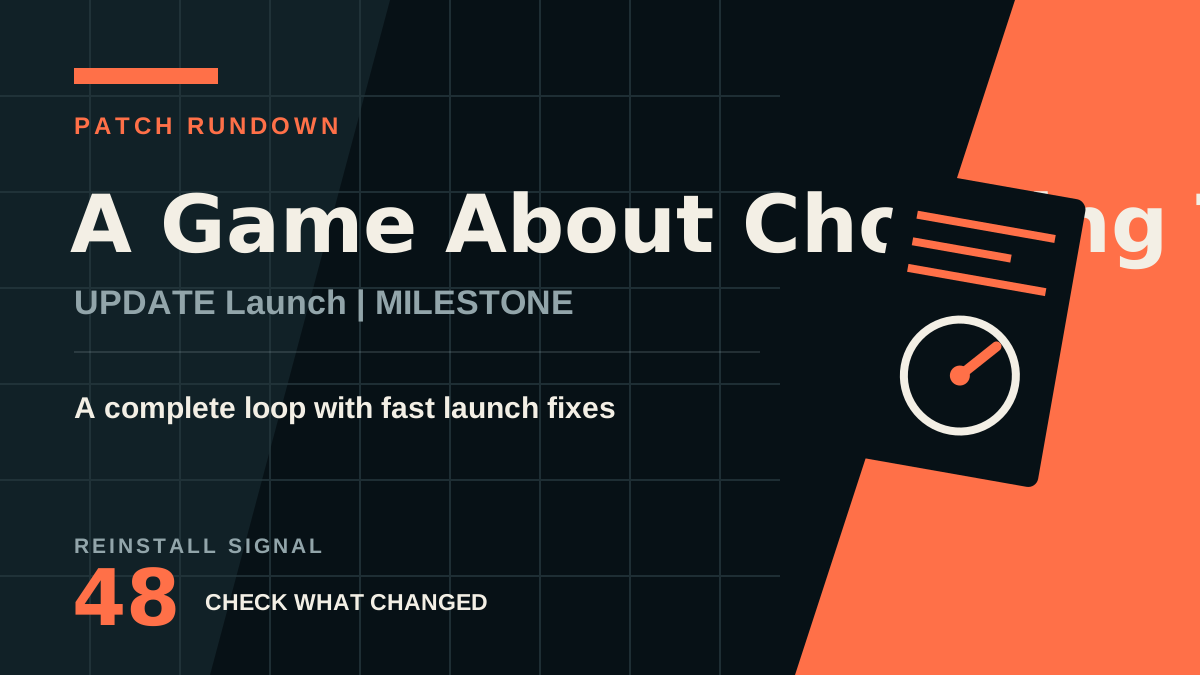
A Game About Chopping Trees launched on Steam on July 15 with a deliberately narrow promise: cut trees, move logs, improve tools, replant forests, and travel between work sites by handcar. It supports solo play and online co-op on Windows and Linux.
The launch earns a deterministic Patch Impact score of 55, which routes it as a Milestone release. Its Reinstall Signal is 48. That is a reason to check the finished loop rather than a declaration that every demo player should rush back. The first post-launch update improves the game players already bought; the announced major free update remains a future plan without published details.
The full release keeps the job simple
The basic progression is intentionally legible. Trees become cash, cash becomes stronger chopping and carrying upgrades, and the handcar connects the forests. Replanting gives cleared areas a continuing purpose, while co-op lets two players divide the work without turning the game into a competitive race.
That simplicity is the main beneficiary and the main limitation. Players who want a low-pressure task loop can understand the objective almost immediately. Players looking for construction, survival pressure, a deep economy, or a campaign full of dramatic turns should not assume those systems are hiding behind the tree line. The official launch material sells rhythm and relaxation, not a lumber-industry spreadsheet wearing hiking boots.
For anyone returning from the demo, the important change is completion rather than reinvention. The commercial release is the point at which the forest loop, upgrades, co-op, achievements, and full route can be judged together.
The first follow-up targets everyday friction
The July 18 update adds an ice igloo to repair in the Dark Forest, two achievements, more Polaroids, and a new Quality of Life upgrade branch that increases sawmill speed. Those additions are small, but the sawmill branch directly reduces waiting inside the central money-making loop.
The fixes are more practical. The developer addressed cloud-save behavior between Windows and Steam Deck, co-op interactions that could lock for clients, trolley-upgrade sharing, camera clipping, beehive visibility in older saves, and replication trouble when many large trees were present. Ice pines can now be sold, and general interaction speed is faster.
Co-op players and Steam Deck users benefit most because several changes remove friction specific to shared play or moving a save between devices. Solo desktop players still receive faster interactions, a clearer upgrade path, and a few new objectives, but this is not a second launch disguised as a hotfix.
Who gains most from the launch build?
The strongest case belongs to pairs who want an activity game rather than a demanding co-op campaign. Shared forest work gives both players an obvious job, and the trolley fix matters because transportation is part of the basic flow instead of optional scenery. The client interaction fix is similarly important: a relaxed game stops being relaxed rather quickly when one player cannot use the things in front of them.
Steam Deck players also gain from the cloud-save correction, provided they move between the handheld and Windows. The notes establish that the developer addressed the specific cross-device save issue; they do not promise a universal cure for every possible synchronization problem.
The update is less transformative for solo players who already finished the launch route without technical trouble. They receive faster interactions, extra collectibles, another repair target, and a useful sawmill branch, but no newly announced forest or alternate progression path. Their reason to return is cleanup and completion, not a fresh campaign.
Returning Player Tax: A
The Returning Player Tax is A. Demo players do not need a research project before picking up the axe again. Start a new session, inspect the upgrade table, confirm how cash and trolley progression behave in co-op, and let the early forest re-teach the loop.
The only meaningful relearning comes from post-demo tuning and the new sawmill-speed branch. The game still communicates its priorities through a short chain: chop, haul, sell, upgrade, travel, repeat.
What remains unresolved
The latest official update says a major free update is in development, but it does not give that update a date, feature list, or release window. That promise should not be counted as current content.
The same notice identifies a current Bluetooth controller problem. Some gamepads connected over Bluetooth may not work correctly, and the developer says it is investigating. Controller players should confirm their setup before treating the launch fixes as a complete reliability pass.
The post-launch notes also do not announce a broader campaign structure, new co-op modes, or a different endgame. Players who left because they wanted a more complex simulation should wait for concrete notes about the larger update. The current fixes improve reliability and pace without changing the game’s deliberately compact identity.
Is launch a genuine reason to return?
Yes, if you liked the demo’s quiet work loop and wanted to see its finished route with co-op and upgrades in place. The rapid follow-up makes the timing better by addressing cloud saves, shared progression, interaction locks, and sawmill speed.
No, if the demo felt too slight. Compared with the pre-release build, launch supplies the complete product and useful polish, but the next substantial content step is still only announced. This is the right moment to judge the game on what it is—not on the much larger forest the developer may plant later.