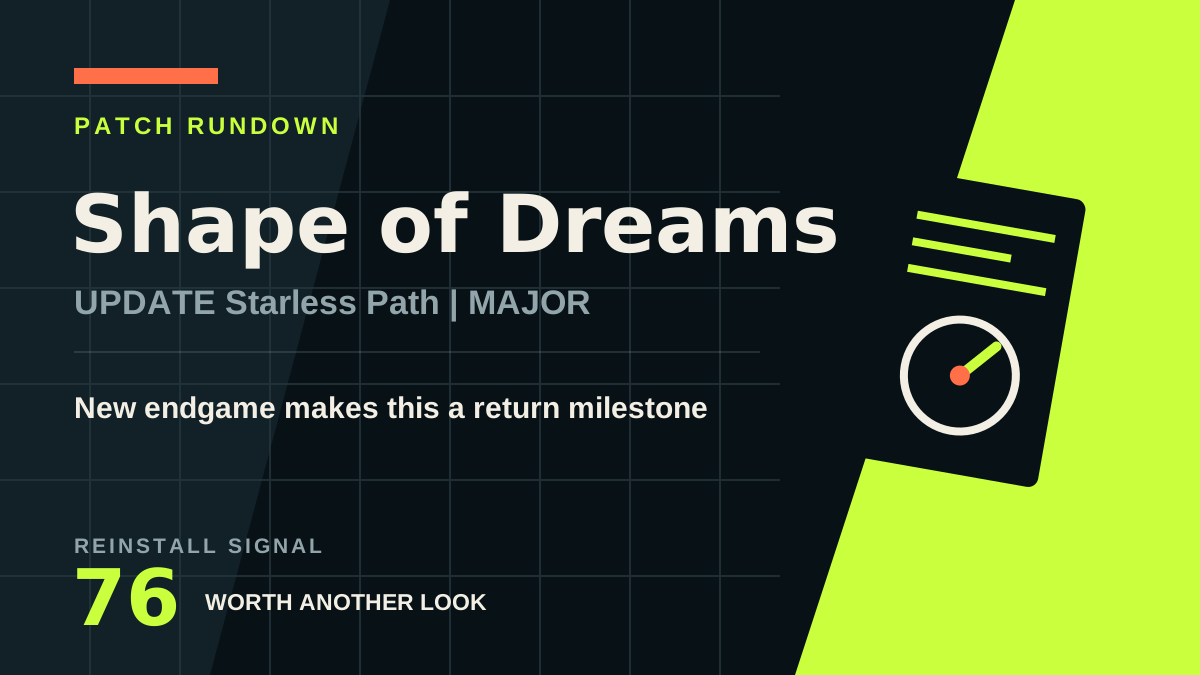
Shape of Dreams’ PS5 launch is paired with The Starless Path, the game’s first-anniversary update and its most consequential return signal so far. The official announcement describes a new platform entry point, four-player cross-play, a new Traveler, a new ending and final boss, new world-boss attacks, and a large pool of Memories and Essences. That is an unusually complete package for a launch-day update: it gives new players a starting point and gives lapsed players a destination to pursue.
The Patch Impact Score is 87. The Reinstall Signal is 76, or Worth Another Look. The Returning Player Tax is C. There is enough new structure to justify relearning the game, but returning players should not expect their old build assumptions to carry unchanged into a new ending route. This assessment uses the official launch announcement and includes no hands-on testing.
The PS5 launch changes the return question
The Starless Path arrives with the PS5 version and four-player cross-play. That makes the update relevant even to players who were already watching the PC version: the community now has a new platform doorway and a shared co-op reason to return. It also means the strongest case is social. A player returning alone can explore the added route, but a group with unfinished build ideas has a clearer reason to schedule a run.
The announcement names nine Travelers and more than 200 Memories and Essences in the launch package. The scale matters because it expands the decision space rather than simply adding a short event. Returning players will have to revisit which Traveler fits their preferred route, how Memories change a build, and which parts of the old setup remain useful after the first-anniversary update.
The new ending is the important content
The Starless Path adds a new ending and final boss, along with Way of Stars and the Cetus Traveler. It also adds secondary attacks for world bosses and six Universal Identity Memories. Those additions point at the endgame rather than the opening hours. A player who stopped after learning the basic loop has a reason to return; a player who already exhausted the old route has a more direct reason to return.
The new ending is also what separates this release from a cosmetic anniversary celebration. The official announcement describes a fresh destination and new combat or build questions, not just a reward track. That gives the update a stronger reinstall signal, although the exact difficulty curve and matchmaking experience are not established by the announcement alone.
What returning players should relearn first
Start by choosing a Traveler and reviewing the Memory pool before attempting the new route. Then check the world-boss changes and reserve time for the new ending rather than treating The Starless Path as a quick introductory mission. Co-op groups should agree on roles and build experiments before a serious run; the update’s value comes from the interaction between its new options, not from a single isolated item.
The unresolved questions are practical rather than cosmetic. PlayStation’s announcement establishes the platform, cross-play, and content scope, but it does not independently establish long-term matchmaking health or performance on every supported setup. There is no verified hands-on testing behind this report, so players should use their own device and network experience to judge those parts after returning.
Compared with a routine balance patch, The Starless Path combines a platform launch with a new ending, final boss, Traveler, build pieces, and world-boss changes. That is a genuine reason to return. The main friction is the breadth of what has changed: a lapsed player needs to relearn the Memory and Traveler vocabulary before the new route makes sense. For players who want a co-op roguelite with a fresh endgame target, this is the clearest reinstall signal in the current Patch Rundown window.
The return case is strongest for players who stopped because the old route had run out of surprises. The new ending gives that group a concrete destination instead of a vague promise of more replay value. Players who stopped because they wanted a different combat style should start with the new Traveler and Memory options, because those are the parts most likely to change how a run feels on paper. The announcement does not provide enough evidence to claim that every old build is obsolete, only that the decision space is wider.
There is a co-op planning benefit as well. Four-player cross-play lowers the friction of bringing back a group, but the content still asks players to coordinate around a route and an endgame target. Returning players should agree on whether the first session is for learning, experimenting, or attempting the new ending. That small choice helps the launch package feel like a meaningful return rather than a menu tour.
The PS5 launch also gives players a clean moment to compare platform and co-op needs. Cross-play is part of the announced package, but the announcement is not a performance test. A returning group should leave room for a short setup session, confirm its preferred controls, and then decide whether the new route deserves the longer commitment.