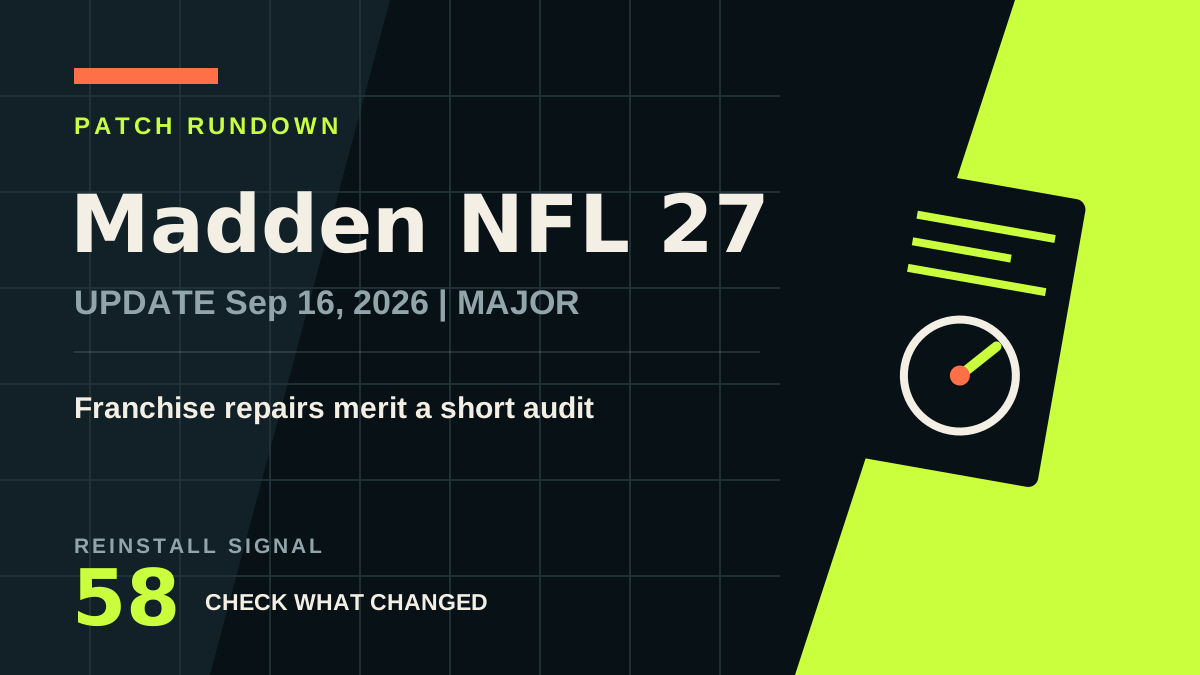
Madden NFL 27’s September 16 title update is a broad repair pass with two different audiences. Franchise players get the most consequential work: free agency, contracts, retirements, salary-cap behavior, online leagues, roster depth, and simulated draft trades all receive attention. Every mode also has to account for gameplay changes around coverage and blocking. That combination makes this more than a routine cleanup, even though it does not add a new headline feature.
The Patch Impact Score is 59. The Reinstall Signal is 58, or Check What Changed. The Returning Player Tax is C. A returning player can get value from the update, but an old Franchise plan and old field-level assumptions both need a quick review. This assessment uses EA’s official notes and includes no hands-on testing.
Franchise is the main reason to come back
The update’s biggest practical benefit is its reach into Franchise administration. Free agency and contract behavior matter because they shape the roster decisions that sit between games. Retirement and salary-cap fixes matter because they can change whether a long-running league remains coherent. Online-league corrections matter because a broken administrative step can stop a group season even when the games themselves are playable.
Returning Franchise players should begin with the state of their league rather than immediately starting a new game. Review contracts, available cap room, retirements, roster depth, and the next draft. EA’s notes still call out CPU salary-cap recovery, roster depth, and simulated draft trades for monitoring, so the update improves the route without making those systems safe to ignore. A player who returns for a long rebuild should keep records of important roster decisions until those remaining edges prove stable over time.
Coverage and blocking can change the field
The second reason to read this update is the gameplay pass. Coverage and blocking adjustments can change the timing of plays that previously felt automatic. The notes are more useful as a relearning checklist than as a promise about exact on-field feel. Revisit the defensive calls, check how receivers separate, and give blocking interactions a few possessions before deciding that an old playbook still works exactly as it did.
This is where the update reaches players who never touch Franchise. Superstar, Presentation, and Ultimate Team also receive targeted fixes, so the patch is not just an administrative repair for one mode. The value is distributed: Franchise players get the strongest return case, competitive players get a reason to study field behavior, and Ultimate Team players get a set of corrections without a new progression reset described in the official notes.
What returning players should check first
Open the mode you care about and compare its current state with your last saved plan. In Franchise, inspect the cap, pending contracts, roster depth, and upcoming draft. On the field, run a short test session focused on coverage and blocking rather than jumping straight into a consequential league game. In Superstar and Ultimate Team, read the mode-specific changes before assuming a familiar menu or challenge behaves the same way.
The remaining issues matter. EA still flags CPU salary-cap recovery, roster depth, and simulated draft trades for monitoring in Franchise. The notes do not establish device-by-device performance or online stability, and there is no verified hands-on testing behind this report. Those limits are especially relevant for players deciding whether to invest in a long league immediately.
Compared with the prior August roster-and-gameplay update, the September release reaches further into Franchise administration while still changing the field-level interaction layer. It is a genuine reason to return for Franchise players whose league has been held back by contract or cap problems. It is a worthwhile check for other players, but not a content expansion. The safest verdict is to reinstall with a short audit plan, then decide whether the repaired systems justify a longer season.
The audit plan should be deliberately small. Check one existing league, one practice or low-stakes game, and one mode-specific menu before committing to a full return. That sequence reveals whether the update solved the problem that caused the player to leave. It also prevents a familiar playbook or a long-term roster decision from becoming the test case for several changes at once.
The update benefits active leagues most because those players can immediately see whether administrative friction has eased. New or lapsed players still gain from the field-level corrections, but the official notes do not promise a new progression arc. That is why the Reinstall Signal is a checkpoint rather than an event: the update is valuable when it addresses a specific reason to return, especially a Franchise problem, and less compelling when the request is for fresh content.
Players who prefer competitive modes should make the same kind of narrow comparison. Pick a familiar coverage call, a blocking concept, and one recent opponent tendency, then use the notes to identify what may have changed. The update rewards attention, not a blind assumption that every prior result still maps cleanly to the current game.